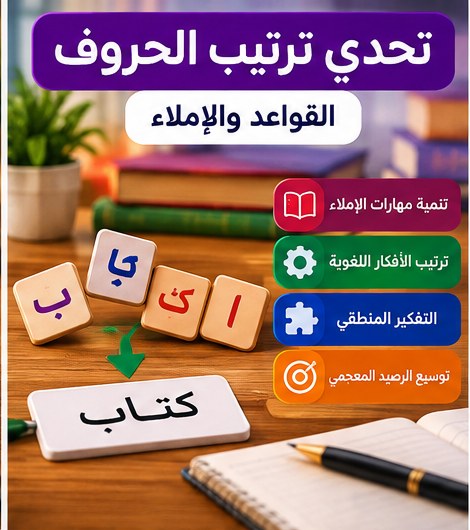
The rules
Each question shows a clue and the letters of a word in random order. You tap the letters in the right order to fill the boxes; a misplaced letter can be removed with one click. A game has ten words and you get 45 seconds per word. You can also type the letters on your keyboard.
Three buttons help you: Hint places one correct letter for you, Clear empties the boxes, and Skip gives up the word and moves on. The game exists in English and French (“word scramble”) and in Arabic (“ترتيب الحروف”), where it also has difficulty levels and a multiplayer mode.
How points are calculated
A solved word is worth 100 points, minus 30 points per hint used (with a minimum of 20). On top of that you get a speed bonus of up to 50 points depending on the time left, and a streak bonus of 10 points per consecutive correct answer, capped at 50. In other words, accuracy and consistency pay more than a single lucky burst. On the overall leaderboard, the game is converted into unified points based on how many of the ten words you solved.
A step-by-step example
Clue: “Organ that pumps blood”. Letters: R, T, A, E, H. First look for common English clusters: TH, HE, EA, ART. “HEART” appears quickly once you place H at the start and T at the end.
The point is that you do not test every combination at random; you lean on the structure of the language. Five letters already allow 120 orders; with three good habits you only try a handful.
An efficient method for unscrambling
- Read the clue before touching the letters — it narrows the field.
- Spot double letters and rare letters (K, W, X, Z, Y, Q).
- Isolate common clusters: in English TH, SH, CH, -ING, -ER, -TION, -LY; in French CH, QU, OU, -TION, -EUR.
- Place the likely ending first, then the beginning.
- Say the result quietly: a word that “sounds wrong” is usually in the wrong order.
- If you are stuck, use one hint rather than skipping the word.
The skills involved
The game works on orthographic memory (the written image of words), recognition of syllables and suffixes, and flexibility: you must drop a hypothesis that leads nowhere and try another. The clue adds a vocabulary dimension, because you have to link a meaning to a written form.
How much you gain depends on how you play. Finding a word by fast random tapping teaches little; taking a moment to understand why an order is right, and then writing the word again, helps you remember it.
Learning from mistakes
After the game, note the words you skipped or solved with a hint. Write each one once without looking, check the spelling, then use it in a sentence. The next day, try to reorder its letters from memory. This kind of spaced retrieval practice is one of the most robust learning strategies identified by educational psychology.
Adapting the exercise to each level
For beginners, choose short words with a very clear clue and allow time without a timer. At intermediate level, use longer words and fewer hints. For advanced players, ask for the meaning, a synonym or a related word after each solution. Avoid raising difficulty and time pressure at once — you would no longer know where errors come from.
The Arabic version: levels and multiplayer
The Arabic version offers four levels (easy, medium, hard, mixed), a quick ten-word challenge or a marathon that lasts as long as you have hearts left, plus multiplayer rooms with a live leaderboard. It is an excellent exercise for learners of Arabic: letters change shape depending on their position, and rebuilding words helps fix those shapes. The tā’ marbūṭa (ة) and alif maqṣūra (ى) almost always go at the end of a word — a valuable clue.
Common mistakes
- Tapping letters at random without reading the clue.
- Ignoring double letters, which blocks the last box.
- Using several hints on the same word instead of thinking about its ending.
- Skipping too quickly: a skipped word scores zero and breaks your streak.
❓ Frequently asked questions
Can several words match the same letters?
It happens (for example “listen” and “silent”). The game expects the word that matches the clue, so always read it first.
Can I use my keyboard?
Yes. Type the letters; Backspace removes the last letter placed.
How much time do I get per word?
45 seconds in English and French. The time left increases your speed bonus.
Do my points count on the leaderboard?
Yes, if you have chosen a player name. Each game is converted into unified points based on your correct answers.
📚 Sources and further reading
- Dunlosky, J. et al. (2013). Improving Students’ Learning With Effective Learning Techniques. Psychological Science in the Public Interest, 14(1). Link
- Roediger, H. L. & Karpicke, J. D. (2006). Test-Enhanced Learning. Psychological Science, 17(3). Link
- Wouters, P. et al. (2013). A meta-analysis of the cognitive and motivational effects of serious games. Journal of Educational Psychology, 105(2), 249–265. Link