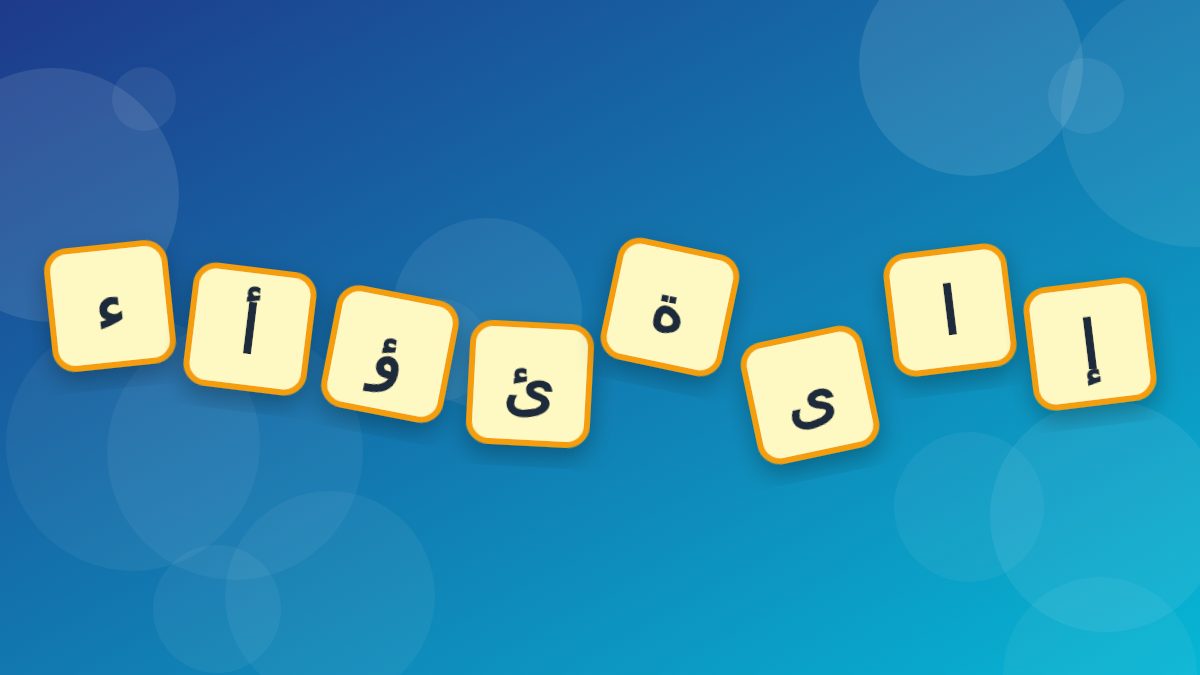
Why these rules are tricky
Arabic is written right to left, and most texts leave out short vowels. Some letters change their “seat” depending on the surrounding vowels — this is the case of the hamza (ء), the glottal stop. Other sounds can be written in two ways depending on the type of word, such as the final “t” or the final long “a”. The good news is that the rules are logical: they depend on vowels, pronunciation and the word’s root.
This guide is for English-speaking learners, parents helping a child who studies in Arabic, and anyone curious about the language. Examples are given in Arabic with a simple transliteration.
Connecting hamza and cutting hamza
The cutting hamza (hamzat al-qaṭ‘) is always pronounced and is written on an alif: أ or إ. Examples: أكل (akala, “he ate”), إلى (ilā, “to”). The connecting hamza (hamzat al-waṣl) is only pronounced at the very start of speech and drops inside a sentence; it is written as a plain alif with no hamza: اكتب (uktub, “write!”), اسم (ism, “name”).
The connecting hamza appears only in specific cases; everywhere else, the hamza is a cutting one:
- the imperative of three-letter verbs: اكتب (uktub), اجلس (ijlis);
- the past, imperative and verbal noun of five- and six-letter verbs: انطلق (inṭalaqa), استخراج (istikhrāj);
- a few nouns to learn: اسم (name), ابن (son), امرأة (woman), اثنان (two);
- the definite article “al-”: البيت (al-bayt).
Hamza in the middle of a word: the strongest vowel wins
To write a hamza in the middle of a word, compare its vowel with the vowel of the letter before it and keep the stronger one. Order of strength: i (kasra), then u (ḍamma), then a (fatḥa), then no vowel (sukūn). Each vowel has its seat:
- i → yā’ seat (ئ): بئر (bi’r, “well”), سُئِل (su’ila, “he was asked”);
- u → wāw seat (ؤ): مؤمن (mu’min, “believer”), رؤوس (ru’ūs, “heads”);
- a → alif seat (أ): سأل (sa’ala, “he asked”), رأس (ra’s, “head”).
Example: in سُئِل the previous letter has u and the hamza has i; i is stronger, so the hamza sits on a yā’. Special case: a hamza with a after a long alif is written on the line: قراءة (qirā’a, “reading”), تساءل (tasā’ala).
Hamza at the end of a word: look only at the letter before
At the end of a word, ignore the hamza’s own vowel and look only at the vowel of the previous letter:
- u before → ؤ: تباطؤ (tabāṭu’, “slowdown”);
- i before → ئ: شاطئ (shāṭi’, “beach”), قارئ (qāri’, “reader”);
- a before → أ: قرأ (qara’a, “he read”), ملجأ (malja’, “shelter”);
- a vowelless letter or long vowel before → on the line: جزء (juz’, “part”), سماء (samā’, “sky”), شيء (shay’, “thing”).
Tā’ marbūṭa (ة) or open tā’ (ت)?
The tā’ marbūṭa (ة) is pronounced “t” when linked to the next word and “h” (or nothing) at a pause. It mostly ends feminine nouns: مدرسة (madrasa, “school”), شجرة (shajara, “tree”), فاطمة (Fāṭima). The open tā’ (ت) is always pronounced “t” and appears:
- in all verbs: كتبت (katabat, “she wrote”);
- in the regular feminine plural: معلمات (mu‘allimāt, “female teachers”);
- in nouns where a vowelless consonant comes before the t: بيت (bayt, “house”), بنت (bint, “girl”), وقت (waqt, “time”).
Final long “a”: ا or ى?
A final long “a” is written either with a straight alif (ا) or with an alif maqṣūra, which looks like a dotless yā’ (ى). The basic rule is to go back to the root:
- three-letter verbs: if the root contains wāw, write ا (دعا da‘ā “he called”, present يدعو yad‘ū); if it contains yā’, write ى (رمى ramā “he threw”, present يرمي yarmī);
- three-letter nouns: the dual or plural reveals the root: عصا (‘aṣā, “stick”, dual ‘aṣawān) but فتى (fatā, “young man”, dual fatayān);
- words longer than three letters: usually ى (مستشفى mustashfā “hospital”, مصطفى Muṣṭafā), unless a yā’ comes before it: دنيا (dunyā, “world”);
- small invariable words: ا, except four to remember: إلى (ilā), على (‘alā), بلى (balā), حتى (ḥattā);
- foreign names: usually ا: أمريكا (Amrīkā), فرنسا (Faransā), except a few famous names such as موسى (Mūsā, “Moses”) and عيسى (‘Īsā, “Jesus”).
Letters that sound alike
Learners often mix up pairs of similar-sounding letters: س and ص (plain and emphatic s), ت and ط (t and ṭ), ذ and ز (dh and z), ض and ظ, د and ض. Changing the letter changes the word: سيف (sayf, “sword”) and صيف (ṣayf, “summer”). Learn such words in pairs, with their meanings.
Common mistakes
- إستخدام instead of استخدام (istikhdām): verbal noun of a six-letter verb, so a connecting hamza.
- شيئ instead of شيء: final hamza after a vowelless letter, so on the line.
- مدرسه instead of مدرسة: feminine noun, so tā’ marbūṭa.
- دعى instead of دعا: root with wāw (يدعو).
- انشاء الله instead of إن شاء الله: three separate words.
Practise with the spelling game
The platform’s Arabic spelling challenge follows exactly these rules in seven progressive stages: similar letters, initial hamza, medial hamza, final hamza, tā’ marbūṭa, alif maqṣūra and a final mixed challenge. A word appears with one letter missing; you pick the right one and the rule is then explained. You can play alone or in a room with friends or a class. The game is in Arabic, but intermediate learners can try it easily with this guide at hand.
❓ Frequently asked questions
Do I need these rules to read Arabic?
To read, recognising the shapes is enough. To write without mistakes, these rules are essential — and they sink in quickly with practice.
Why are some words spelled differently in different countries?
There are a few school variants, such as مسؤول or مسئول (“responsible”). What matters is staying consistent within a text.
How do I know a word’s vowels when they are not written?
Say the word slowly or check a vowelled dictionary. With practice, the vowels become obvious.
Is the spelling game suitable for beginners?
It is designed for native speakers and intermediate learners. Beginners can start with stage one, with a teacher or this guide alongside.