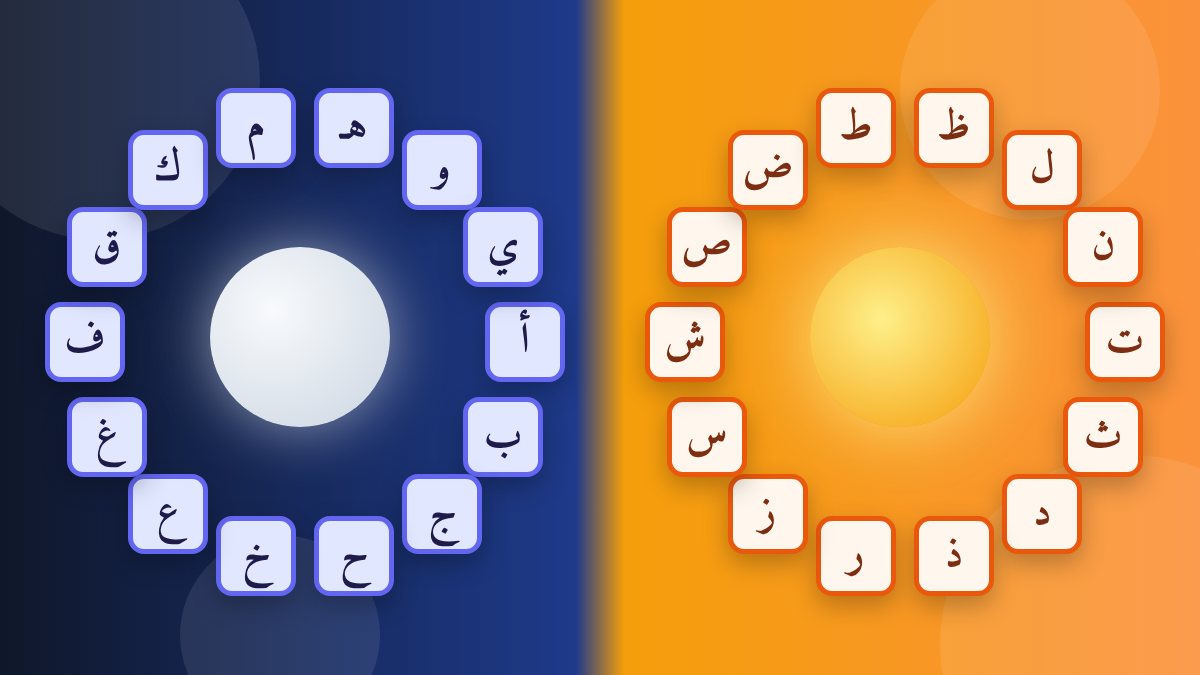
What are sun and moon letters?
When the article "ال" comes before a noun, the lām is always written, but how it sounds depends on the next letter:
- moon letter: the "l" is pronounced, as in al-qamar (the moon), al-kitāb (the book), al-bayt (the house);
- sun letter: the "l" disappears and the next letter is doubled, as in ash-shams (the sun), an-nūr (the light), ar-rajul (the man).
The names come from those two famous words: "الشمس" starts with a sun letter (shīn) and "القمر" with a moon letter (qāf).
The list
Sun letters (14): ت ث د ذ ر ز س ش ص ض ط ظ ل ن.
Moon letters (14): أ ب ج ح خ ع غ ف ق ك م هـ و ي.
As a memory aid, Qur’an teachers use the phrase "ابغِ حجَّك وخَفْ عقيمَه", in which every letter is a moon letter. The sun letters are the first letters of the words in a line from the same teaching poem ("Tuḥfat al-Aṭfāl" by al-Jamzūrī).
Why does the "l" disappear?
The reason is phonetic. Lām is made with the tip of the tongue, and every sun letter is also made with the tip of the tongue, near the teeth or the gum ridge. Two such close sounds merge naturally: the "l" assimilates into the next consonant, which becomes doubled. This is called assimilation (idghām).
Moon letters are made far from the tongue tip: with the lips (ب م و), the back of the tongue (ق ك ج) or the throat (ع ح هـ غ خ أ), so the "l" stays audible.
Writing and vowel marks
Golden rule: the lām is always written, even when it is silent. In a vowelled text:
- before a moon letter, the lām carries a sukūn: الْقَمَر;
- before a sun letter, the lām stays bare and the next letter carries a shadda: الشَّمْس.
You already know this rule
You can see it in Arabic names written in Latin letters: "نور الدين" becomes Nur ad-Din or Noureddine because dāl is a sun letter, and "عبد الرحمن" becomes Abd ar-Rahman. But "عبد القادر" stays Abd al-Qadir, because qāf is a moon letter.
Exercise
Sort these words into sun and moon words, then check by saying them aloud: السماء (the sky), الجبل (the mountain), التفاحة (the apple), الورد (the roses), الذهب (the gold), الكتاب (the book).
Answers: sun: السماء، التفاحة، الذهب. Moon: الجبل، الورد، الكتاب.
❓ Frequently asked questions
Is the lām dropped in writing before a sun letter?
No. It is always written; only the pronunciation changes. In vowelled text, the shadda on the sun letter shows the assimilation.
Is jīm (ج) a sun or a moon letter?
It is a moon letter in Standard Arabic, so we say al-jamal (the camel), although some dialects pronounce it differently.
Does the same rule apply when reciting the Qur’an?
Yes. Tajwīd teachers call it "iẓhār qamarī" (moon clarity) and "idghām shamsī" (sun assimilation).