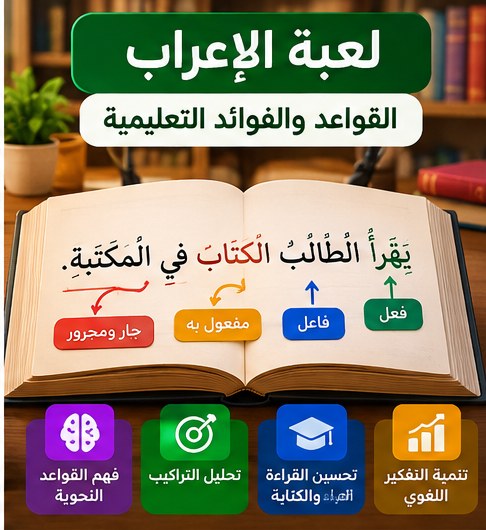
What is i‘rāb?
I‘rāb (الإعراب) describes the function of each word in a sentence and the marker that shows it at the end of the word. The same noun can be a subject, a predicate, a direct object or the object of a preposition, and its ending changes with that role. English has almost lost its cases, but traces remain in pronouns: “he” (subject), “him” (object), “his” (possessive). Arabic applies cases to every noun.
Understanding i‘rāb helps you read vowelled texts correctly, understand who does what in a sentence with flexible word order, and avoid mistakes in writing and speech. It is also a core part of Arabic teaching in schools from Mauritania to Iraq.
The four cases and their main markers
- Nominative (raf‘, الرفع): main marker, the vowel u (ḍamma). Used for the subject, the topic of a nominal sentence and its predicate.
- Accusative (naṣb, النصب): main marker, the vowel a (fatḥa). Used notably for the direct object.
- Genitive (jarr, الجر): main marker, the vowel i (kasra). Used after prepositions and for the second term of a possessive construction.
- Jussive (jazm, الجزم): specific to present-tense verbs, marked by the absence of a vowel (sukūn), for example after the negation “lam”.
Example: قرأَ الطالبُ الكتابَ (qara’a ṭ-ṭālibu l-kitāba, “the student read the book”). “Qara’a” is a past-tense verb; “aṭ-ṭālibu” is the subject, nominative with u; “al-kitāba” is the direct object, accusative with a.
Flexible word order
Thanks to cases, Arabic can move words around without losing the meaning. قرأ الكتابَ الطالبُ (qara’a l-kitāba ṭ-ṭālibu) still means “the student read the book”: the ending, not the position, tells you who is reading. This flexibility is used for emphasis, but it means you have to read final vowels carefully.
Secondary markers you need to know
Some categories of words use other markers:
- Dual: nominative in -āni, accusative and genitive in -ayni (جاء الطالبان / رأيت الطالبين).
- Sound masculine plural: nominative in -ūna, accusative and genitive in -īna (المعلمون / المعلمين).
- Sound feminine plural: the accusative takes i instead of a (رأيت الطالباتِ).
- The “five nouns” (abū, akhū, ḥamū, fū, dhū): ū in the nominative, ā in the accusative, ī in the genitive (أبوك، أباك، أبيك).
- Diptotes (nouns that refuse nunation, such as Aḥmad): genitive in a instead of i when indefinite (مررت بأحمدَ).
- The five verb forms (yaktubūna, etc.): the final n drops in the subjunctive and jussive (لن يكتبوا).
Visible or implied markers
Sometimes the marker cannot be seen. In الفتى (al-fatā, “the young man”), the word ends in an alif, which cannot carry a vowel, so the marker is implied (muqaddara). In القاضي (al-qāḍī, “the judge”), the u and i are implied because they would be heavy to pronounce, but the a appears: رأيت القاضيَ.
A reliable method for analysing a sentence
- Identify the type of sentence: verbal (starts with a verb) or nominal (starts with a noun).
- Find the verb or the topic (mubtada’).
- Find the subject or predicate, then the complements.
- Spot the “governors”: prepositions, particles such as inna, kāna and its sisters, negations.
- Check whether the word belongs to a special category (dual, plural, five nouns, diptote).
- Write the function and marker of each word, then read the sentence aloud.
An example of a governor at work
Compare: الطالبُ مجتهدٌ (aṭ-ṭālibu mujtahidun, “the student is hard-working”) and إنّ الطالبَ مجتهدٌ (inna ṭ-ṭāliba mujtahidun, “indeed, the student is hard-working”). The particle “inna” puts the topic into the accusative (a), while the predicate stays nominative. With كان (kāna, “was”) it is the other way round: كان الطالبُ مجتهدًا — the topic stays nominative and the predicate becomes accusative.
The i‘rāb challenge: learn by playing
The grammar page is now a full game, “تحدي الإعراب”. Each round is a fully vowelled sentence: 3 words at easy level, 4 to 5 at medium, 5 to 6 at hard. You analyse the words in order: the current word is highlighted and you choose its i‘rāb out of four options before the 20 seconds run out. After each word you see its full analysis, and at the end of the sentence a table sums up the i‘rāb of the whole sentence.
- Three levels: easy (subject, object, subject and predicate of nominal sentences, prepositions, construct state…), medium (كان and إنّ and their sisters, dual and sound masculine plural, subjunctive and jussive, circumstantial and adverbial words…) and hard (absolute object, object of purpose, object of accompaniment, specification, exception, vocative, the five nouns and five verbs, diptotes, implied markers).
- Game modes: solo, a daily challenge that is the same for everyone, and rooms of up to twenty players — ideal in class.
- Points: each correctly analysed word earns 10 points plus the seconds left; your result becomes unified leaderboard points based on the share of correct words, as in every other game.
The game stays in Arabic whatever the interface language, since it is about Arabic grammar.
Using the platform’s analysis tool
The i‘rāb tool lets you type an Arabic sentence and get an analysis of each word with its function and marker. To get real value from it:
- Analyse the sentence yourself first, on paper.
- Compare your analysis with the tool’s, word by word.
- Where they differ, go back to the rule: who is right, and why?
- Write a new sentence on the same pattern and analyse it without help.
The tool relies on an artificial intelligence model, so it can make mistakes with ambiguous or unvowelled sentences. Treat it as a revision assistant, not an infallible judge.
What the exercise offers — and its limits
Practising i‘rāb helps you see the relationships in a sentence and justify your choices rather than rely on instinct. Practice becomes really useful when followed by an explained correction and a fresh example. On the other hand, analysing sentences in a tool does not by itself guarantee mastery of grammar: you also need to read, write and apply the rules in new contexts.
Common learner mistakes
- Deciding the case from the word’s position rather than its function.
- Forgetting the effect of “inna” and “kāna”.
- Giving an indefinite diptote an i in the genitive.
- Keeping the final n of the five verb forms after “lan” or “lam”.
❓ Frequently asked questions
Do Arabic speakers always pronounce these endings?
In spoken dialects most case endings have disappeared. They remain essential in Modern Standard Arabic: in writing, the media, Qur’anic recitation and literature.
Should I add vowels before analysing a sentence?
It is not required, but vowels greatly improve accuracy, especially for ambiguous sentences.
Why does the tool disagree with my textbook?
A sentence may allow two correct analyses, or the tool may be wrong. Rely on your teacher or a reference grammar, and on context.
Where should a beginner start?
With simple verbal sentences (verb, subject, object), then nominal sentences, then “inna” and “kāna”. A mistakes notebook reviewed weekly helps a lot.