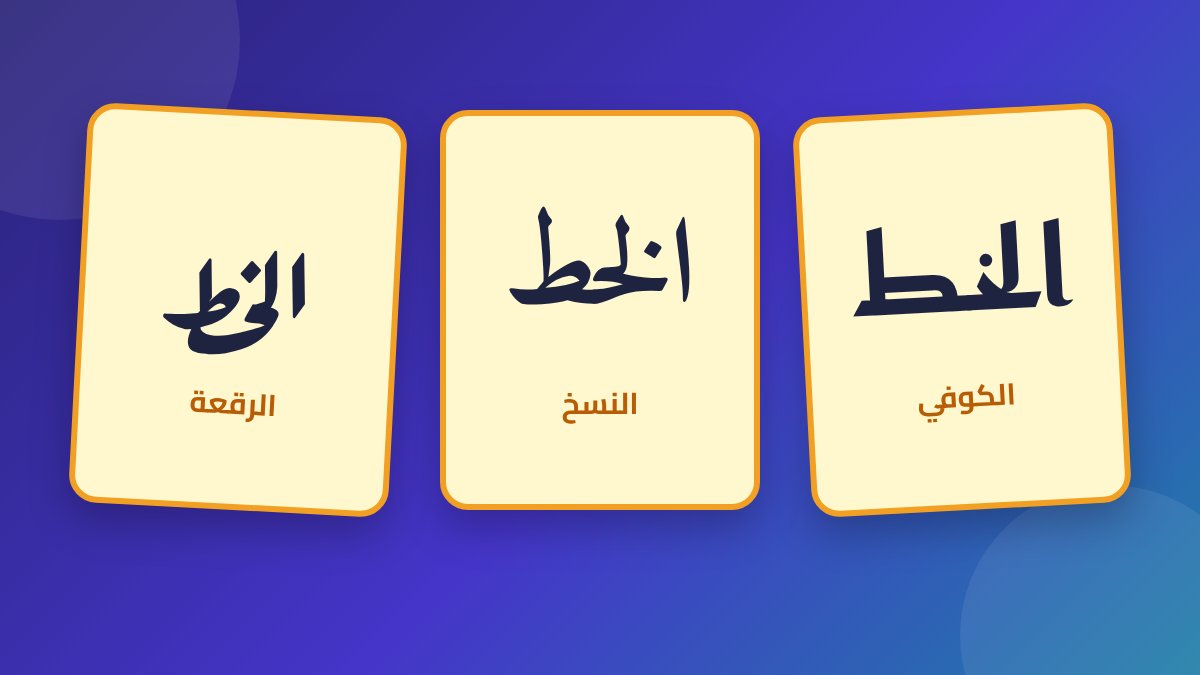
From writing to art
When Arabic writing first appeared, its letters had few dots and simple shapes; the goal was simply to record. But the need to copy the Qur’an with great care, and later to produce official registers and letters, pushed scribes to refine and harmonise the letters. Over the centuries calligraphy became an art in its own right, with masters, students and an ijaza (licence) granted after years of training, much like a diploma today.
What sets Arabic script apart is that its letters join, and most of them change shape at the start, middle and end of a word. That flexibility lets a calligrapher stretch a letter or stack several on top of one another, turning a single word into a picture.
Kufic: a geometric beginning
Kufic takes its name from the city of Kufa in Iraq and is one of the oldest known Arabic styles. You can recognise it by its sharp angles and straight horizontal and vertical strokes, as if drawn with a ruler. Many Qur’an manuscripts from the early centuries are written in Kufic, and it also appears on coins and mosque walls.
Over time it branched into many varieties: foliated Kufic, whose letters end in leaves; plaited Kufic, with interlaced letters; and square Kufic, in which words are fitted into squares like a mosaic, often seen on tiles and building façades.
Ibn Muqla and “proportioned” script
In the tenth century the vizier and calligrapher Ibn Muqla (d. 940) turned calligraphy into a measurable science. He took the rhombic dot made by the tip of the reed pen as his unit, made the alif the yardstick for every other letter, and built the rounded letters on a circle whose diameter is the alif. The system is called al-khatt al-mansub, “proportioned script”, because every letter stands in a fixed ratio to the others.
Ibn al-Bawwab (d. 1022) refined the method, followed by Yaqut al-Musta‘simi (d. 1298), who is credited with cutting the pen nib at a slant, giving the letters more grace. His name is linked to the “six pens” (al-aqlam al-sitta): thuluth, naskh, muhaqqaq, rayhani, tawqi‘ and riqa‘.
The major styles and what defines them
- Naskh: clear and balanced, named after the copying (naskh) of books and Qur’ans. It is the basis of most modern Arabic typefaces.
- Thuluth: nicknamed the “mother of scripts”, it is the hardest and grandest. Its letters stretch and curve, and words can overlap. You will see it in book titles and on the gates and domes of mosques. Calligraphers say that whoever masters thuluth will find the others easy.
- Ruq‘a: quick, simple and unadorned, with short letters; the two dots of ta’ or qaf often become a small dash. It is the everyday handwriting of the Arab East, and its codification is credited to the Ottoman calligrapher Mumtaz Bey in the nineteenth century.
- Diwani: born in the Ottoman chancery (diwan) for decrees and sultans’ letters. Its round, slanting, tightly packed letters made it hard to forge. Its variant jali diwani fills the gaps with ornaments and dots.
- Persian (nasta‘liq): developed in Iran; flowing, slanted and with long horizontal strokes, it seems to hang in the air. It is widely used for poetry.
- Maghribi: the script of North Africa and al-Andalus, derived from Kufic and grown rounder. A tell-tale sign: fa’ has one dot below and qaf one dot above.
How to identify a style at a glance
- Are the letters geometric, with right angles? It is probably Kufic.
- Does fa’ have a dot below and qaf a single dot above? It is Maghribi.
- Do pairs of dots become a dash, with short letters and a quick hand? It is ruq‘a.
- Are the letters round, packed together, with lines rising at the end? It is diwani.
- Are the letters long and stretched, with words stacked into a grand composition? It is thuluth.
- Are the letters clean and sitting evenly on the line, like a printed book? It is naskh.
The calligrapher’s tools
The basic tool is the qalam, traditionally cut from reed or bamboo and trimmed with a special knife to a width that suits the style. Then comes the ink, once made from soot and gum, kept in an inkwell with a tuft of silk or wool called the liqa that controls how much ink the pen takes up. The paper was coated with starch or egg white and burnished with a smooth stone, so the pen would glide and mistakes could be wiped away.
A student begins with long drills called mashq, repeating the same letter hundreds of times under the master’s eye, then moving on to words and then to lines. In the classical tradition, students only sign their work after receiving the ijaza from their master.
Calligraphy and learning today
Calligraphy may look like a craft for professionals, but it helps anyone learning Arabic. Copying letter shapes slowly strengthens visual memory, helps you tell similar letters apart (ح ج خ or س ش) and improves school handwriting. Many teachers open a lesson with a few minutes of ruq‘a or naskh before dictation.
Letter games need a quick eye too, one that spots a letter wherever it sits in a word. Word search, for example, trains you to pick out letters side by side in a grid, a skill very close to reading calligraphy.
❓ Frequently asked questions
What is the oldest Arabic script?
The earliest surviving Arabic writings use a slanted script known as Hijazi. Kufic then became dominant in the first centuries and gave rise to the later styles.
Which style should I start with?
Most learners start with ruq‘a, which is simple, fast and useful day to day, then move on to naskh, leaving thuluth and diwani for an advanced stage.
Do I need a reed pen to begin?
No. A chisel-tip calligraphy marker or a flat-nib fountain pen is enough. What matters is that the tip is cut wide, because the beauty of the letters comes from the stroke getting thicker or thinner with its direction.
Why did UNESCO add Arabic calligraphy to its intangible heritage list?
Because it is a living practice passed from master to student and tied to identity, knowledge and the arts in many countries. The nomination was submitted in 2021 on behalf of sixteen Arab countries.
📚 Sources and further reading
- Hashim Muhammad al-Baghdadi. Qawa‘id al-khatt al-‘arabi (The Rules of Arabic Calligraphy). Link
- Al-Qalqashandi. Subh al-a‘sha fi sina‘at al-insha (vol. 3, chapter on writing). Link
- Blair, Sheila S. (2006). Islamic Calligraphy. Edinburgh University Press. Link
- UNESCO. Arabic calligraphy: knowledge, skills and practices (2021). Link