Where did the Arabic script come from?
Most scholars trace the Arabic script to the Nabataean script, used in northern Arabia and the southern Levant, which itself descends from Aramaic. Over the centuries, Nabataean letters became more joined and rounded until they looked like Arabic letters.
The Namara inscription (around 328 CE) is written in the Arabic language but in Nabataean letters. Later inscriptions, such as the one at Harran (568 CE), are already close to the Arabic script. In other words, the Arabic language existed before it had a script of its own.
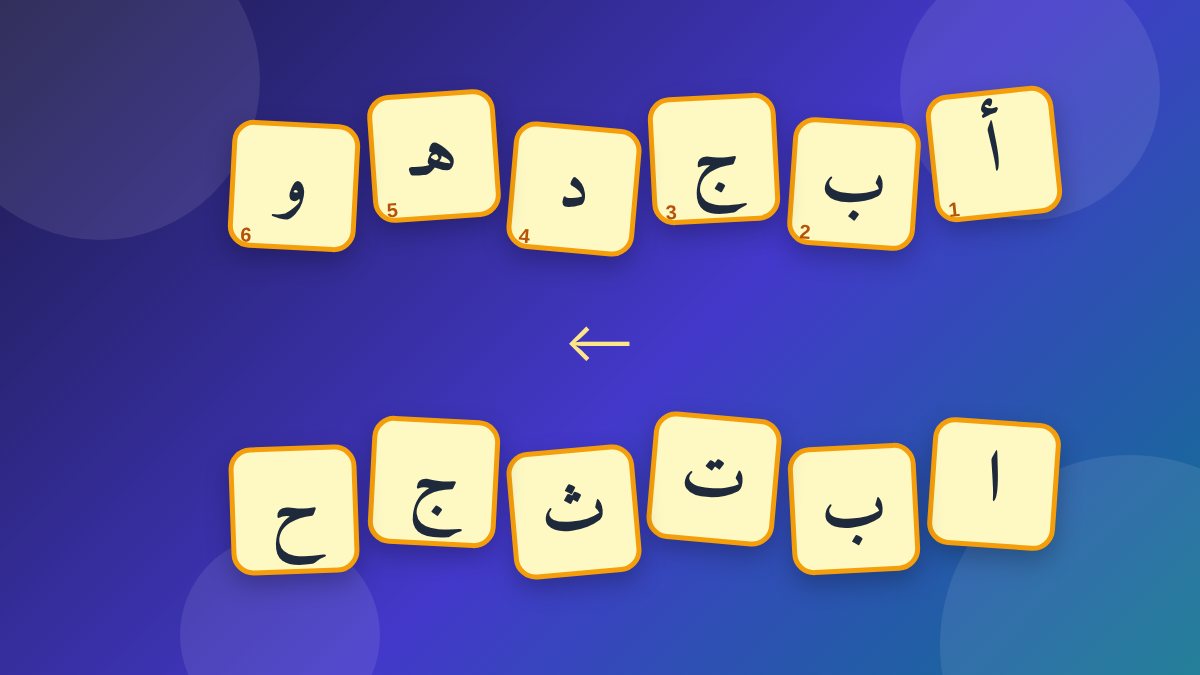
The abjad order: "abjad, hawwaz, ḥuṭṭī, kalaman"
The abjad order is the old one, originally shared with other Semitic alphabets. It is memorised through words that have no meaning of their own:
- abjad, hawwaz, ḥuṭṭī, kalaman, sa‘faṣ, qarashat;
- thakhadh, ḍaẓagh.
The first six words hold 22 letters matching the ancient Semitic alphabets. The last six (ث خ ذ ض ظ غ) stand for sounds specific to Arabic and were appended at the end. In North Africa the ending is slightly different: "ṣa‘faḍ, qarasat, thakhadh, ẓaghash".
Abjad numerals: when letters become numbers
In the abjad order every letter has a value: units for the first nine, then tens, then hundreds, and finally ghayn = 1000.
- أ=1, ب=2, ج=3, د=4, هـ=5, و=6, ز=7, ح=8, ط=9;
- ي=10, ك=20, ل=30, م=40, ن=50, س=60, ع=70, ف=80, ص=90;
- ق=100, ر=200, ش=300, ت=400, ث=500, خ=600, ذ=700, ض=800, ظ=900, غ=1000.
So the word "كتب" (he wrote) equals 20 + 400 + 2 = 422. Poets used this for chronograms: a line of verse whose letters add up to the year of an event.
The modern (hijā’ī) order: "alif, bā’, tā’, thā’"
The order taught in schools today groups letters of the same shape and then tells them apart with dots: ب ت ث, then ج ح خ, then د ذ, then ر ز. Tradition attributes it to Naṣr ibn ‘Āṣim and Yaḥyā ibn Ya‘mar at the end of the first Islamic century. North Africa uses a variant whose second half differs.
Dots and vowel marks
In early Arabic writing, letters of the same shape were often left undotted, and readers relied on context. As Islam spread, the script needed to be more precise, in two steps:
- Vowel dots, attributed to Abū al-Aswad al-Du’alī: coloured dots marking the vowels a, i and u.
- Diacritic dots, which tell ب from ت and ث, attributed to Naṣr ibn ‘Āṣim and Yaḥyā ibn Ya‘mar.
Later, al-Khalīl ibn Aḥmad (died around 786) replaced the coloured dots with today’s signs: fatḥa is a small alif, ḍamma a small wāw, kasra a small yā’ below the letter. Al-Khalīl also ordered the letters by place of articulation, from the throat to the lips; because his list began with ‘ayn, his famous dictionary is called "Kitāb al-‘Ayn".
Quick facts
- Arabic has 28 letters; some count 29 by treating hamza separately from alif.
- 15 letters carry dots: ب ت ث ج خ ذ ز ش ض ظ غ ف ق ن ي.
- 13 letters have none: ا ح د ر س ص ط ع ك ل م هـ و.
- Letters also split into 14 "sun" letters and 14 "moon" letters.
- Arabic is nicknamed "the language of ḍād" (ض), a sound long seen as typical of the language.
How does this help in letter games?
Knowing the history of the letters helps you see how they relate. Because letters of the same shape sit side by side in the modern order, you can move mentally from ب to ت to ث when searching for words. Try this: pick two neighbouring letters, such as ج and ح, and find three words for each in one minute.
❓ Frequently asked questions
What is the difference between the abjad and hijā’ī orders?
Abjad is the old order ("abjad, hawwaz…") linked to numerical values; the hijā’ī order ("alif, bā’, tā’…") groups letters of the same shape and is used today in dictionaries and schools.
Why do ث خ ذ ض ظ غ come last in the abjad?
They represent Arabic sounds that had no letter of their own in the older Semitic alphabets, so they were added after the original 22 letters.
Who added the dots to the letters?
Tradition credits the vowel dots to Abū al-Aswad al-Du’alī, the diacritic dots to Naṣr ibn ‘Āṣim and Yaḥyā ibn Ya‘mar, and today’s vowel signs to al-Khalīl ibn Aḥmad.