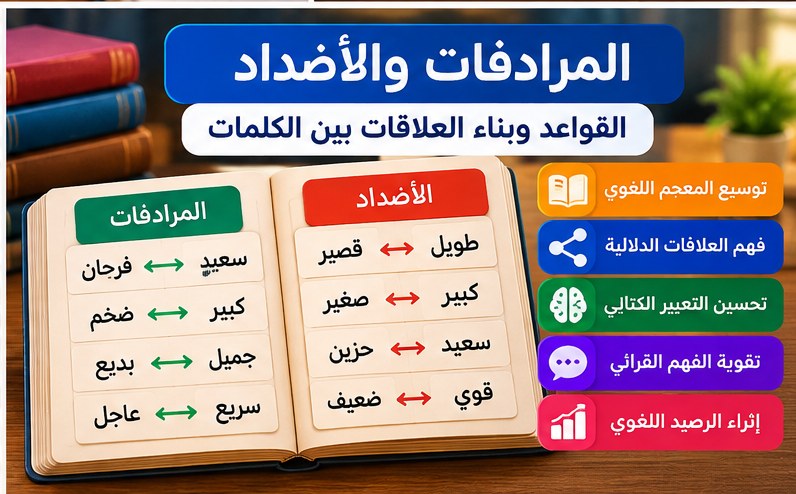
Synonym or antonym: what are we talking about?
A synonym is a word with a close meaning: “glad” and “happy”, “fast” and “quick”. An antonym expresses the opposite meaning: “big” and “small”, “open” and “close”. It sounds simple, but language is rarely that tidy. Most synonyms are not interchangeable in every sentence: you take a “quick look”, not really a “fast look”, and a “big mistake” is not quite a “large mistake”.
That is why the game asks for the closest or most opposite word among four options, not a perfect synonym. After each answer, a short explanation clarifies the relationship between the two words.
Rules and scoring
A game has ten questions of fifteen seconds each. Before starting, you choose the theme: synonyms and antonyms mixed, synonyms only or antonyms only. A correct answer earns 100 base points plus a speed bonus of up to 50 points. In solo mode, the next question appears as soon as you answer.
The Arabic version also has a group mode: everyone sees the same question at the same time. When all players have answered, the question ends two seconds later without waiting for the timer. Answer time is measured by the server so that the speed bonus stays fair. On the overall leaderboard, each game is converted into unified points based on your correct answers.
Perfect synonyms are rare
Linguists generally agree that total synonymy — two words identical in meaning and use in every context — is very rare. “Begin” and “commence” mean the same thing, but “commence” is far more formal. “House” and “home” refer to similar things, yet “home” carries feelings that “house” does not. Synonyms often differ in:
- register: informal, neutral or formal (“kid”, “child”, “offspring”);
- intensity: “glad”, “happy”, “delighted”, “ecstatic”;
- grammar: some verbs need a preposition, others do not;
- connotation: “thrifty” is positive, “stingy” is negative.
The different kinds of antonyms
- Complementary antonyms: no middle ground, such as “alive” and “dead”.
- Gradable antonyms: degrees in between, such as “hot” and “cold” (“warm”, “cool”).
- Relational antonyms: a two-way relationship, such as “buy” and “sell”, “give” and “receive”.
- Directional antonyms: “up” and “down”, “enter” and “exit”.
Knowing these categories helps you avoid traps: for “warm”, neither “hot” nor “cold” is a perfect opposite.
A worked example
Word: “generous”. Task: the opposite. Options: “rich”, “stingy”, “kind”, “poor”. “Poor” is the opposite of “rich”, not of “generous”. “Kind” is a neighbour, almost a synonym. “Rich” is about money, not behaviour. The correct answer is “stingy”, which describes the opposite behaviour: keeping things for yourself instead of giving.
The example shows that you must first identify the domain of the word — here, attitude towards others — before looking for its opposite.
Building a vocabulary network
Memorising isolated pairs is not very effective. It is better to build a small network around each word: one or two synonyms with their nuance, an antonym, a word from the same family and an example sentence. For “courage”: “bravery” (neutral), “daring” (riskier), opposite “cowardice”, family “courageous”, “discourage”.
After a game, pick three words you met and build their network on a card. Review the cards a few days later, trying to recall the words before reading them — retrieval practice, one of the best-validated learning methods.
What the game can offer
Choosing quickly between close words forces you to activate their precise meaning, compare and eliminate. The explanations after each answer turn mistakes into learning opportunities. These benefits stay modest if you just click fast; they become real when you read the explanations and reuse the words in context, in writing or speech.
Activities for class and family
- Synonym chain: each person gives a synonym of the previous word and explains the nuance.
- The thermometer: rank words from weakest to strongest (“warm”, “hot”, “scorching”).
- Hidden opposite: one player describes a word without saying it; the others find its antonym.
- The online game: one ten-question game, followed by a discussion of the mistakes.
Common mistakes
- Choosing a word from the same topic instead of a true synonym (“school” is not a synonym of “pupil”).
- Confusing the opposite of a word with the opposite of a neighbouring word.
- Ignoring register or connotation.
- Guessing in the last seconds instead of eliminating impossible options.
❓ Frequently asked questions
Why was my answer rejected when it looked correct?
The game expects the closest option among the four. Your choice may have been close, but the correct one is more precise in this context; the explanation shown tells you why.
Is the game available in Arabic?
Yes, with an Arabic word bank and a group mode with automatic rooms. The English and French versions have their own word banks.
How long is each question?
Fifteen seconds. The faster you answer, the bigger the speed bonus.
Can I play with friends?
Yes in the Arabic version, whose group mode puts several players on the same questions. In English and French the game is played solo — compare your scores on the leaderboard.