The basic rules
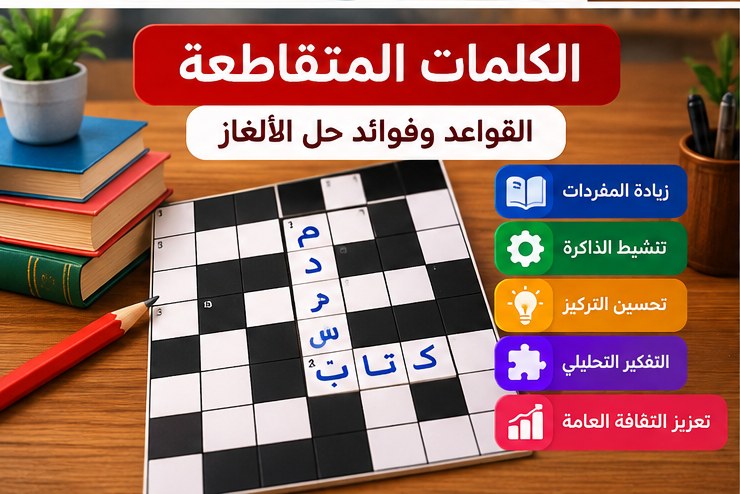
A crossword grid is made of white and black squares. Each answer reads either across or down, and each clue gives the number and direction of the word you are looking for. The key feature is that words cross: a single square belongs to two words at once, so every letter you find helps you uncover others.
Start with the clues you know for sure. Write the word in the right direction, then move to the words that cross it. A shared square is valuable information: once a letter is certain, it sharply limits the options for the perpendicular word.
When you do not know an answer, do not fill squares at random. Make a mental note of the clue, move elsewhere, and come back once the neighbouring words have revealed a few letters.
An example of reasoning
If the clue is “Capital of Morocco” and the answer has five squares, general knowledge suggests “RABAT”. If one of those letters crosses a word clued “Pet that purrs” in three squares, “CAT” fits — and its “A” must match the shared square. If it does not, either the first answer is in the wrong place or another three-letter word is needed. That back-and-forth between hypothesis and check is exactly what makes the game valuable.
For a language clue such as “Synonym of joy”, several answers exist: “glee”, “delight”, “happiness”. The word length and the letters already placed let you decide.
Game modes on the platform
Crosswords are available in Arabic, French and English, each with its own bank of words and clues. There are three modes:
- Solo grid: a new grid every game, a difficulty level of your choice, and the option to resume an unfinished grid.
- Daily challenge: one grid for every player on the same day, so you can compare results fairly.
- Multiplayer rooms: everyone solves the same grid with a live leaderboard, chat and each player’s progress percentage.
On phones, a floating keyboard can be dragged anywhere so it never hides the grid.
How scoring works
Each correct letter and each completed word earns points, with a bonus for finishing the whole grid. A hint reveals one letter for a small penalty. On the overall leaderboard, only completed grids are recorded, so that repeated unfinished attempts do not count. As with the other games, each result is converted into unified points between 10 and 100.
Reading clues like a pro
Clues come in different types, and recognising the type saves time:
- Direct clue: “Capital of Japan” — general knowledge.
- Language clue: “Opposite of difficult” — a relationship between two words.
- Descriptive clue: “Animal that carries its home” — a mental picture that leads to the word.
- Form hints: singular or plural, tense, part of speech — they fix the exact form of the answer.
What you actually practise
Solving a grid means retrieving information from memory, understanding how a clue is phrased and testing a hypothesis against the number of squares and the letters available. Revisiting an answer also teaches you to revise a hypothesis instead of clinging to it.
Difficulty depends on vocabulary, the player’s knowledge of the topic and how clear the clues are, so we cannot claim that every grid trains every cognitive function. Some studies find that older adults who do crosswords regularly score better on certain tests, but these studies show an association, not necessarily a cause: curious, active people may simply play more. Crosswords remain an enjoyable, stimulating activity, best combined with reading, physical activity and social life.
A method that avoids guessing
- Read all the clues and fill the certain ones first.
- Use every crossing letter to narrow down the neighbouring words.
- For a hard clue, think of three candidates and discard those with the wrong length.
- Never force a word that contradicts a confirmed letter.
- Use a hint as a last resort, on the square that unlocks the most words.
Turning the grid into vocabulary practice
After solving, pick three new words. Write your own definition and an example sentence for each, and look for a synonym, an opposite or a related word. In class, ask students to justify their answers instead of simply announcing the solution.
Make flashcards: the clue on one side, the word and its meaning on the other. Try to recall the word before flipping the card, then review it a few days later. The grid becomes a starting point for learning, not just entertainment.
Tips for beginners and experienced solvers
Beginners: start with short, direct words and feel free to skip a clue. Experienced solvers: watch out for form traps (plural, tense, part of speech), abbreviations and clues with double meanings. For everyone, the daily challenge is a great five-to-ten-minute ritual.
Common mistakes
- Forcing an answer that “looks right” even though a crossing letter contradicts it.
- Forgetting an article or a letter that changes the word length.
- Staying stuck on a single clue for too long.
- Erasing a correct word because you doubt another one: check the shared square first.
❓ Frequently asked questions
Does the grid change every game?
Yes in solo mode: a new grid is built from the word bank. The daily challenge stays the same for everyone until midnight.
Can I finish a grid later?
Yes. Your browser keeps the unfinished grid and offers to resume it when you come back.
How do I type Arabic without an Arabic keyboard?
Use the page’s floating keyboard: it shows the letters of the selected language and can be moved anywhere.
Why don’t my points appear on the leaderboard?
Only fully solved grids are recorded, and you need to have chosen a player name. A short delay between two results prevents automated repeat submissions.
📚 Sources and further reading
- Pillai, J. A. et al. (2011). Association of crossword puzzle participation with memory decline in persons who develop dementia. Journal of the International Neuropsychological Society, 17(6). Link
- Sailer, M. & Homner, L. (2020). The Gamification of Learning: A Meta-analysis. Educational Psychology Review, 32, 77–112. Link
- Wouters, P. et al. (2013). A meta-analysis of the cognitive and motivational effects of serious games. Journal of Educational Psychology, 105(2), 249–265. Link