What is ‘arud?
‘Arud is the science that tells a metrically sound line from a broken one. It was founded by al-Khalil ibn Ahmad al-Farahidi (d. 786), the Basran scholar who also compiled the first Arabic dictionary, *Kitab al-‘Ayn*. Tradition says that while walking through the coppersmiths’ market he heard the rhythm of hammers on metal and realised that poetry has a rhythm that can be measured. Legend or not, al-Khalil studied the poetry of the Arabs and sorted it into fifteen metres (buhur, literally “seas”). His student al-Akhfash later added a sixteenth, the *mutadarik*.
A classical line is made of two halves: the first is called the sadr, the second the ‘ajuz. Every line of a poem ends on the same rhyme, built on a shared final letter called the rawi.
Step 1: prosodic spelling
‘Arud cares about what you hear, not what is written. So you rewrite the line the way it sounds, following a few rules:
- What is pronounced but not written gets written: tanwin becomes a nun (kitabun → كتابُنْ), and a doubled letter (shadda) is written twice, the first without a vowel.
- What is written but not pronounced is dropped: the connecting alif in mid-sentence, the “sun” lam (wa-sh-shams → وشْشمس), and the silent alif of «كتبوا».
- The final vowel of the line is lengthened: “manzili” becomes “manzilī”.
Step 2: symbols and feet
Next, mark every voweled letter with a slash ( / ) and every unvoweled letter with a zero ( 0 ). The word «كَتَبْ» (katab, at a pause) becomes ( //0 ). These marks group into feet (taf‘ilat), dummy words used only for measuring, like centimetres on a ruler. The eight main ones:
- fa‘ūlun ( //0/0 ) and fā‘ilun ( /0//0 );
- mafā‘īlun ( //0/0/0 ) and fā‘ilātun ( /0//0/0 );
- mustaf‘ilun ( /0/0//0 ) and mutafā‘ilun ( ///0//0 );
- mufā‘alatun ( //0///0 ) and maf‘ūlātu ( /0/0/0/ ).
Step 3: a full example in tawil
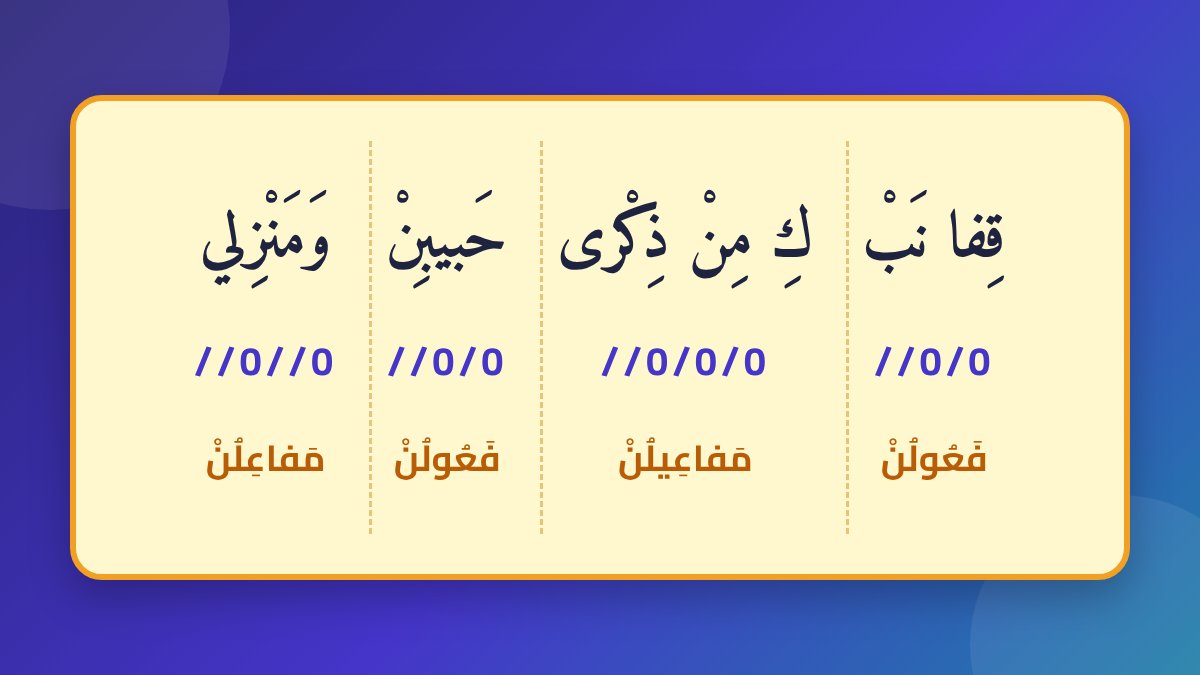
Take the first half of the most famous line in pre-Islamic poetry, by Imru’ al-Qays: «قِفا نَبْكِ مِنْ ذِكرى حَبيبٍ ومَنزِلِ» (“Halt, let us weep at the memory of a beloved and a campsite”).
- Prosodic spelling: قِفا نَبْ / كِ مِنْ ذِكْرى / حَبيبِنْ / وَمَنْزِلي.
- Symbols: ( //0/0 ), then ( //0/0/0 ), then ( //0/0 ), then ( //0//0 ).
- Feet: fa‘ūlun mafā‘īlun fa‘ūlun mafā‘ilun.
This is the tawil (“long”) metre, one of the most common in early poetry. The last foot is mafā‘ilun (short i) rather than mafā‘īlun: an accepted change explained below.
A second example in basit
Al-Mutanabbi wrote: «الخيلُ والليلُ والبيداءُ تعرفُني» (“The horses, the night and the desert know me”).
- Prosodic spelling: أَلْخَيْلُ وَلْ / لَيْلُ وَلْ / بَيْداءُ تَعْ / رِفُني.
- Symbols: ( /0/0//0 ), ( /0//0 ), ( /0/0//0 ), ( ///0 ).
- Feet: mustaf‘ilun fā‘ilun mustaf‘ilun fa‘ilun.
This is the basit (“spread out”) metre. The final foot, fa‘ilun, is fā‘ilun with its long ā dropped.
Zihaf and ‘illa: why lines are never identical
If poets followed the feet to the letter, poetry would be monotonous. So ‘arud allows specific variations. A zihaf is a light change to a syllable, such as fā‘ilun becoming fa‘ilun; it does not have to be repeated in the rest of the poem. An ‘illa affects the end of the half-line and must be kept throughout the poem, like the final mafā‘ilun of the tawil. These variations give each metre its flexibility; they don’t mean the line is wrong.
The sixteen metres
Here are the metres with their feet for one half-line, in their most common form (some are also used in a shortened version called majzu’):
- Tawil: fa‘ūlun mafā‘īlun fa‘ūlun mafā‘īlun.
- Madid: fā‘ilātun fā‘ilun fā‘ilātun.
- Basit: mustaf‘ilun fā‘ilun mustaf‘ilun fā‘ilun.
- Wafir: mufā‘alatun mufā‘alatun fa‘ūlun.
- Kamil: mutafā‘ilun mutafā‘ilun mutafā‘ilun.
- Hazaj: mafā‘īlun mafā‘īlun.
- Rajaz: mustaf‘ilun mustaf‘ilun mustaf‘ilun.
- Ramal: fā‘ilātun fā‘ilātun fā‘ilun.
- Sari‘: mustaf‘ilun mustaf‘ilun fā‘ilun.
- Munsarih: mustaf‘ilun maf‘ūlātu mustaf‘ilun.
- Khafif: fā‘ilātun mustaf‘ilun fā‘ilātun.
- Mudari‘: mafā‘īlun fā‘ilātun.
- Muqtadab: maf‘ūlātu mustaf‘ilun.
- Mujtathth: mustaf‘ilun fā‘ilātun.
- Mutaqarib: fa‘ūlun fa‘ūlun fa‘ūlun fa‘ūlun.
- Mutadarik: fā‘ilun fā‘ilun fā‘ilun fā‘ilun.
To make them easier to remember, the poet Safi al-Din al-Hilli wrote a “key” for each metre: a half-line that names the metre while following its rhythm, such as «طويلٌ له دونَ البحورِ فضائلُ» (“The tawil has virtues the other metres lack”).
Recognising a metre by ear
- Mutaqarib is quick and regular, like marching steps: “ta-tum-tum, ta-tum-tum”.
- Kamil is broad and full of short syllables; it suits enthusiasm and pride.
- Ramal and khafif are smooth and common in song.
- Tawil is calm and long; it suits storytelling, wisdom and elegy.
- Rajaz is the simplest and closest to speech, which is why it was used for teaching poems such as Ibn Malik’s *Alfiyya* on grammar.
‘Arud in modern poetry
In the late 1940s, free verse based on the foot (shi‘r al-taf‘ila) appeared with Nazik al-Mala’ika and Badr Shakir al-Sayyab. It did not abandon ‘arud; it only freed the number of feet per line. The poet repeats one foot as many times as the meaning needs, mostly using metres built on a single repeated foot (kamil, rajaz, ramal, mutaqarib, mutadarik). Understanding the feet is still useful for reading contemporary poetry.
How ‘arud helps in poetry games
In the Poetry challenge, you pick the missing word of a line. The options are sometimes close in meaning or share the rhyme. That is when the metre decides: the right word is the one that keeps the rhythm of the line. Read the line with each option and you will hear that only one “sits right”. That is the practical value of ‘arud: a musical ear that helps you memorise, understand and enjoy.
❓ Frequently asked questions
Do I need to learn all the technical terms to understand ‘arud?
No. To begin with, master prosodic spelling, the symbols and the eight feet, then learn to recognise the five most common metres: tawil, basit, kamil, wafir and mutaqarib.
Which metre is used most?
In early poetry the tawil leads, followed by kamil, basit and wafir. In modern poetry kamil, rajaz, mutaqarib and ramal dominate, because their feet repeat easily.
Where does the word “‘arud” come from?
One explanation is that poetry is “presented” (tu‘rad) to it to be judged; another is that it was a name for Mecca, where al-Khalil is said to have developed his method.
Does dialect poetry follow the same rules?
It shares the idea of a regular rhythm, and many of its metres are close to al-Khalil’s, but it has its own names and forms, and its pronunciation differs from Classical Arabic.