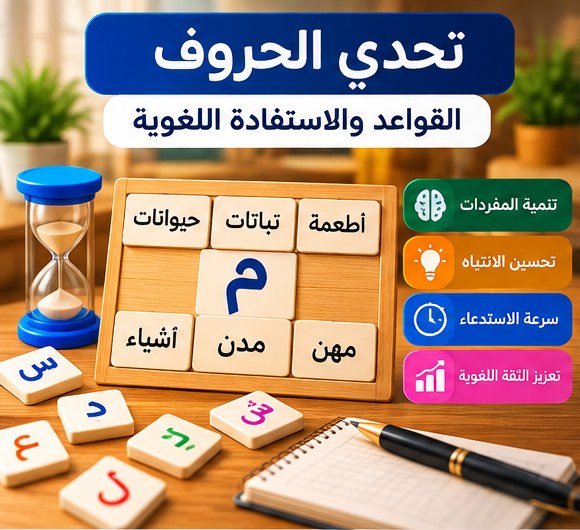
Approved words
Checking starts with a look-up in the words already approved and stored in the game dictionary, which is specific to each language (Arabic, French, English). This first pass gives a fast, consistent result for known words without re-evaluating the same answer every game.
A word’s validity also depends on the round’s conditions: the requested letter and the chosen category. A word that is correct in the language does not necessarily fit every question.
When the word is unknown
Some words are not yet in the dictionary, especially rare first names or vocabulary that has never come up before. Depending on configuration, these cases can go through additional verification instead of being rejected automatically.
The answer is then examined in the context of the question: does it start with the right letter? Does it belong to the category? Is its meaning appropriate? Is it written legibly? A word’s absence from the dictionary does not, on its own, prove that it is wrong.
Spelling normalisation
The same word can be written in several ways: accents, capital letters, extra spaces, and in Arabic different forms of hamza, alif maqṣūra or tā’ marbūṭa. Normalisation lets spellings be compared more consistently, without changing a word’s meaning or making two different words identical.
- Extra spaces at the start and end are removed.
- Accents and capital letters are ignored in English and French (“Éléphant” = “elephant”).
- Forms of alif and hamza are handled under controlled rules in Arabic.
- No letter that changes the meaning is ignored.
Letter, category and meaning
An accepted answer is more than a correctly spelled word: it must start with the requested letter, belong to the category and carry the intended meaning. If the category is “animal”, a word that starts with the right letter but names a job or an object does not fit.
Some answers are debatable because of regional usage or multiple meanings. Such cases are better handled through careful review than through overly broad rules.
When does the result appear?
In modes evaluated after the round, the final result appears when time runs out or when every player has submitted. This avoids giving anyone an advantage during the competition and lets the same rules apply to everyone.
The role of AI and its limits
Smart verification helps evaluate a word that is not in the dictionary, but it is not an infallible dictionary. It can make mistakes with rare words, proper nouns or category context. Its result is an aid within the checking system, not a substitute for clear rules or for human review of disputed cases. Learn more about AI in the game.
Examples
Letter and category: with the letter M and the category “animal”, “monkey” fits; “market” does not, even though it starts with the same letter.
Spelling and meaning: an extra space or a missing capital letter is fixed by normalisation. However, if changing one letter gives a different word (“boat” / “goat”), the two are not treated as identical.
Reporting an incorrect result
If you think a correct answer was rejected or an unsuitable one accepted, use the feedback form on the results page or contact us. Give the word exactly as you wrote it, the letter, the category and a short description of the problem. A report does not change anything immediately: each case is reviewed before being added to the dictionary.
How we keep competition fair
- The same rules apply to all players in the same conditions.
- We distinguish a word’s correctness from its fit with the letter and category.
- Disputed cases are reviewed before being added to the dictionary.
- Data is improved gradually, without adding uncertain words.
- We acknowledge that automatic checking can make mistakes.
Important note
Tahadi Al Horouf is an independent project under continuous development. The checking system aims for consistent results and a good game experience; it is not an official linguistic reference and does not replace recognised dictionaries.
❓ Frequently asked questions
Why was a correct word rejected?
It may not be recorded yet, it may not match the letter or category, or its spelling may differ from the expected form. Send a report with the round details.
Is a word missing from the dictionary always wrong?
No. It only means it was not found in the local data; it may need additional verification.
Is the AI always right?
No. It can make mistakes, especially with rare or ambiguous cases, which is why reviewing reports remains important.
Does a report get the word accepted immediately?
No. It allows the case to be reviewed, without guaranteeing a change before verification.